Bow legs and knock knees can be a normal part of early childhood, but persistent, uneven or worsening alignment needs a closer look. By the end, you will know which age-related patterns are expected, what to record before an appointment, how specialists identify the cause and when treatment can improve a growing child’s movement and leg alignment.
Key takeaways
- Physiologic bow legs usually improve by age 2.
- Record asymmetry, pain, limping, stiffness, and changes before assessment.
- Standing X-rays can show bone alignment and growth-plate involvement.
- Treatment depends on age, cause, severity, and remaining growth.
When Are Bow Legs or Knock Knees Part of Normal Growth?
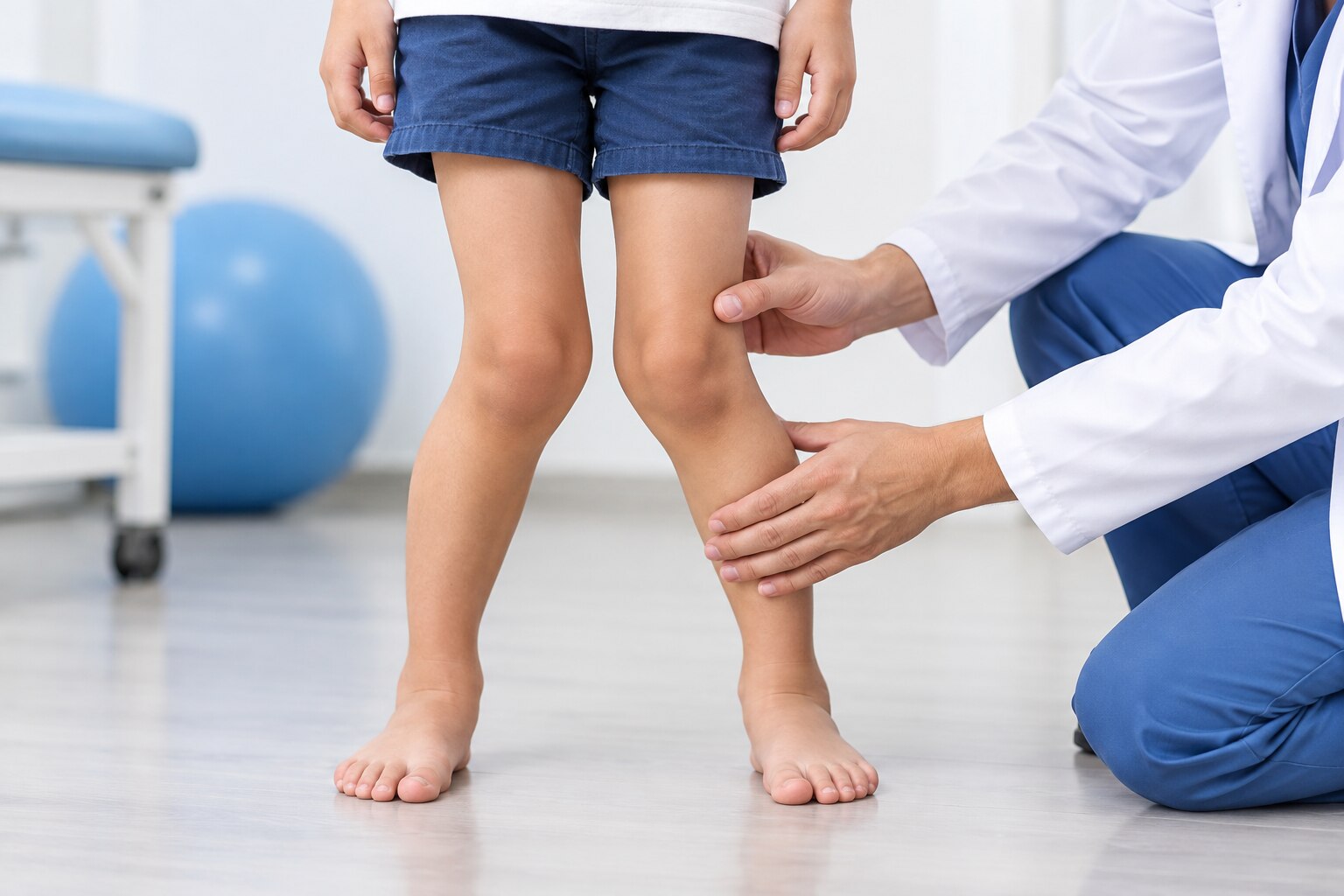
Infant bow legs are commonly a normal growth pattern. Physiologic bowing usually improves toward straight alignment by about age 2; children can then pass through mild knock knees, which usually settle into the adult pattern by ages 7–8. Symmetry, painless movement and steady improvement support normal development.
Arrange an assessment if the alignment is worsening, markedly unequal or limited to one leg. Seek review sooner if your child has:
- Knee or leg pain
- A limp or difficulty running
- Restricted knee movement
- Short stature or poor growth
- Bowing that remains pronounced after age 2
- Knock knees that remain severe after age 7–8
- Deformity after an injury
These features can point to conditions such as Blount disease, rickets or a growth-plate injury rather than a harmless developmental variation. Do not rely on repeated over-the-counter braces alone.
For a useful appointment record, photograph your child standing barefoot from the front and take a short walking video. Note whether the knees or ankles touch naturally, and measure the gap between the ankles with knees together for knock knees, or between the knees with ankles together for bow legs.
A symmetrical, painless pattern that is improving rarely needs immediate correction; routine braces, special shoes and exercises do not change that natural course. Parents searching for bow legs treatment children in Bengaluru should seek paediatric deformity experience, not just an adult knee service.
Warning Signs Parents Should Record Before an Appointment
Record the pattern for two to four weeks instead of relying on memory. Arrange an assessment sooner if the change is worsening, affects one leg more than the other, or comes with pain, limping, difficulty running, reduced knee movement, or noticeably short stature.
- Photograph your child barefoot from the front and back while standing naturally, with the camera at knee height. Repeat under the same conditions.
- Take a short walking and running video from the front, back and side. Include stairs if movement there is difficult.
- With feet together and knees relaxed, measure the gap between the ankles for bow legs. With ankles together, measure the gap between the knees for knock knees. Do not force the legs into position.
- Note the date, pain location, duration, night pain, limp, falls and whether symptoms follow activity.
- Record previous fractures, infections, nutritional concerns, poor growth, or a family history of limb deformity.
| Finding | What to record | Why assessment matters |
|---|---|---|
| One-sided alignment | Which leg looks different and whether the difference is increasing | Asymmetry is less consistent with a simple developmental pattern |
| Pain or limp | Trigger, duration and effect on walking | These symptoms need examination rather than repeated home observation |
| Progressive gap | Knee or ankle measurement with dates | A growing gap can indicate deformity requiring imaging or treatment |
Do not start high-dose vitamin D or rely on over-the-counter braces without clinical advice. A clinician planning child knee deformity treatment in Bengaluru needs the child’s growth history, examination and measurements, not appearance alone.
What a Paediatric Orthopaedic Assessment and X-Ray Can Show
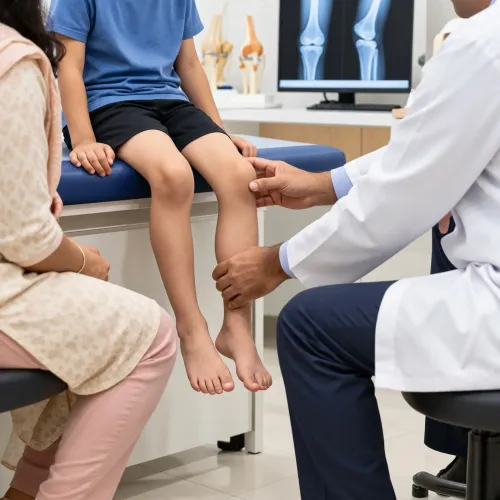
The clinician examines the child standing and walking, not just the knees on an examination table. The assessment looks for the pattern and cause of the deformity, because the visible angle alone cannot show whether the problem lies in the femur, tibia, growth plate or whole limb.
Key findings include:
- Age, height and growth pattern, including short stature or signs of rickets
- Symmetry, progression and whether one leg is more affected
- Pain, limp, running difficulty and restricted knee movement
- Hip, knee and ankle position, leg-length difference and walking alignment
- Previous fracture, infection, growth-plate injury or nutritional illness
- Evidence suggesting Blount disease or another skeletal condition
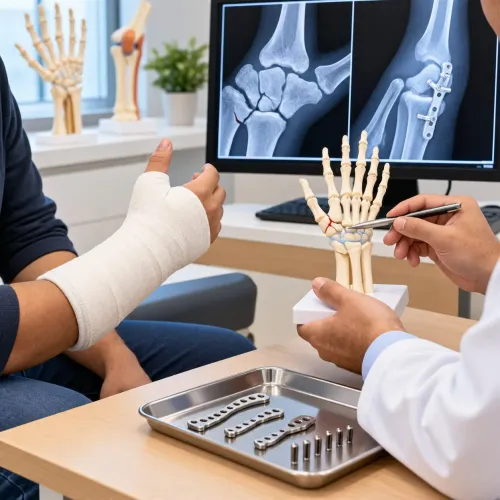
A standing, weight-bearing full-length radiograph becomes especially useful when the deformity is persistent, substantial, asymmetric or worsening. It shows the hip, knee and ankle on one image, allowing the clinician to trace the mechanical axis and identify whether the angular error comes mainly from the femur, tibia or both.
The image also shows growth plates, bone shape and signs of an old injury or metabolic bone disease.
A small child with normal, symmetrical alignment does not automatically need an X-ray. Families researching knee deformity correction children in Bengaluru should ask which radiographic measurements will guide treatment, how remaining growth will be estimated, and what follow-up will detect rebound correction.
How Treatment Choices Benefit a Growing Child
Observation suits mild, age-appropriate alignment with no pain, limp or progression; it avoids unnecessary treatment while growth is still expected to improve the shape. Medical treatment targets a cause, not the bone angle itself: prescribed vitamin D and calcium can treat nutritional rickets, but they will not reliably straighten an established fixed deformity.
| Option | Main benefit | When it applies |
|---|---|---|
| Observation | Avoids surgery while tracking natural correction | Mild, symmetrical deformity with reassuring examination and expected growth remaining |
| Medical treatment | Corrects an underlying disorder and protects future growth | Rickets, growth-plate disease or another diagnosed cause; treatment follows blood tests and imaging |
| Guided growth | Gradually improves alignment through remaining growth | Angular deformity in a child with meaningful growth left; a plate and screws slow one side of the growth plate |
| Corrective osteotomy | Realigns the bone immediately | Severe deformity, little growth remaining, or a pattern unsuitable for gradual correction |
Guided growth offers less surgical burden than osteotomy, but timing matters. Too little growth leaves inadequate correction; missed reviews or rebound deformity can undo the benefit, especially in younger children and Blount disease. Hardware also needs monitoring and often removal after correction.
Osteotomy can help when waiting would worsen walking mechanics, but it brings greater short-term pain and risks involving healing, fixation, wounds and nerves or blood vessels. For child knee deformity treatment in Bengaluru, ask how age, remaining growth and measurements determine the choice.
Search terms such as knee deformity correction children in Bengaluru do not prove paediatric expertise.
Choosing the Right Specialist and Follow-Up Plan in Bengaluru
A suitable clinician should assess growth, cause and alignment—not judge the knees by appearance alone. Ask whether the doctor routinely treats growing children and has managed guided growth, growth-plate injuries, rickets, Blount disease and deformities after fracture or infection.
Use this checklist before choosing child knee deformity treatment in Bengaluru:
- How will you estimate remaining growth, and which growth plates are involved?
- Will you assess the femur and tibia separately?
- Which standing X-ray measurements will guide treatment: mechanical axis, mechanical lateral distal femoral angle or medial proximal tibial angle?
- How will age, height, symmetry, pain, limp and progression change the plan?
- How frequently will you review the child, and will each visit include examination and imaging?
- What will you do if correction stops early, overcorrects or rebounds?
- What symptoms require an earlier appointment?
A “knock knees specialist in Bengaluru” may still focus mainly on adult knee surgery. Compare the service directly:
| Care setting | Evidence to look for | Risk of a poor fit |
|---|---|---|
| Paediatric orthopaedic service | Growth-plate assessment and childhood deformity experience | Lower chance of treating appearance without cause |
| Adult knee practice | Joint replacement or arthroscopy expertise | May miss growth-related planning |
| Mixed practice | Named experience with guided growth and limb-alignment imaging | Verify who will review the child |
Dr Harish Madrekar's Orthopaedic Clinic can be included in your comparison if the consultation answers these questions clearly and provides a dated follow-up schedule. Consistent reviews matter more than a promise of rapid correction.
Related service
KNEE DEFORMITY CORRECTION IN CHILDREN Knee deformities in children and adolescents can affect the alignment, growth, walking pattern and long-term function of the lower limbs. View service → |
Frequently asked questions
When are bow legs or knock knees part of normal growth?
Infant bow legs often improve toward straight alignment by about age 2. Mild knock knees can follow and usually settle into the adult alignment by ages 7–8. Symmetry, painless movement, and steady improvement support normal development.
Which warning signs should parents record before an appointment?
Record whether one leg looks different, pain or swelling, limping, stiffness, falls, walking changes, and whether the alignment is worsening. Note when you first noticed the change and bring earlier photographs or medical reports.
What can a paediatric orthopaedic assessment and X-ray show?
The assessment checks walking pattern, leg symmetry, hip and knee movement, limb length, and alignment. A standing long-leg X-ray can show the angle of the legs, the location of the deformity, bone structure, and growth-plate involvement.
How can treatment benefit a growing child?
Treatment aims to improve alignment, reduce abnormal load on the knees, protect function, and support comfortable walking and activity. Observation suits improving developmental alignment; bracing or guided-growth surgery is considered for selected persistent or progressive deformities.
How should parents choose a specialist and follow-up plan in Bengaluru?
Choose a specialist who evaluates children, explains the cause and growth outlook, and states when imaging is needed. Ask how often alignment will be reviewed, which changes require an earlier visit, and whether treatment is needed now or observation is safer.
Keywords