A suspected broken collarbone needs more than a sling and a painkiller: first check for skin, nerve, blood-flow, breathing and chest-injury warning signs. Once imaging defines the fracture, you can compare sling care, bracing, rehabilitation and fixation against your healing risks, work demands and tolerance for surgery.
Key takeaways
- Support the arm in a sling and avoid pressing on a visible deformity.
- Use X-rays and examination to identify fracture location, displacement and skin risk.
- Sling treatment suits many stable fractures without threatened skin or nerve injury.
- Surgery becomes urgent when bone threatens the skin or damages nearby nerves or blood vessels.
What should you do immediately after a suspected collarbone fracture?
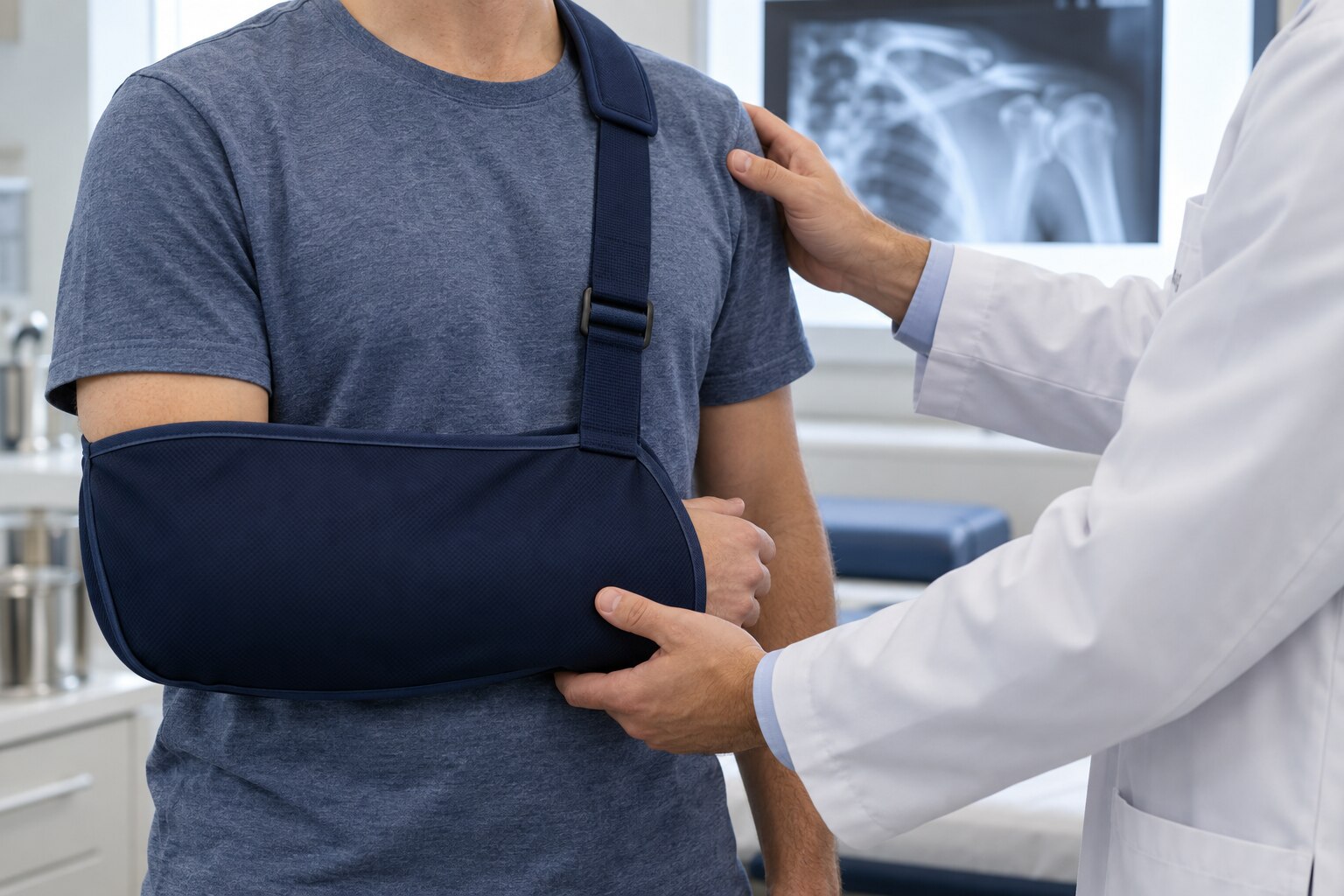
Support the injured arm immediately in a simple sling, or hold it against your body with the opposite hand. Keep the shoulder still and avoid pressing on a visible deformity, because pressure can push bone against the skin or damage nearby tissue.
Use this first-aid sequence:
- Apply ice wrapped in a cloth for 15 to 20 minutes at a time. Never place ice directly on the skin.
- Consider paracetamol according to the pack instructions and your personal medical advice.
- Ask a doctor or pharmacist before using ibuprofen or another anti-inflammatory if you have kidney disease, a stomach ulcer, take blood-thinning treatment, are pregnant, or have an operation planned.
- Arrange medical assessment even when pain improves. Pain relief does not show that the bone is stable.
Go straight to an emergency department for an open wound, skin tightly tented by bone, a cold or pale hand, a weak or absent pulse, worsening numbness or weakness, breathing difficulty, chest pain, or major chest trauma. Do not drive yourself if the arm is badly painful or you feel faint.
These findings can change broken collarbone treatment in Bengaluru from routine fracture care to emergency orthopaedic, vascular or chest assessment in a hospital. Without those warning signs, protect the arm and arrange prompt X-rays and clinical examination before choosing a sling, brace or surgery.
What must the X-ray and clinical examination establish?
Diagnosis and treatment planning start with shoulder and clavicle X-rays, not the label “fracture” alone. The images and examination must establish:
| Imaging | What it should establish | When used |
|---|---|---|
| Shoulder and clavicle X-rays | Medial, midshaft or distal location; displacement; measured shortening when relevant; comminution; joint involvement; shoulder-blade or rib injury | Usual first tests |
| CT scan | Fracture detail hidden on X-ray, joint extension, complex pattern, shoulder-blade or rib injury, or suspected nonunion | When plain films do not answer the treatment question |
Distal fractures need separate attention. If the coracoclavicular ligaments are disrupted, the fragments can remain mechanically unstable; an unstable Neer-type pattern carries a higher nonunion risk than a stable distal fracture. Ask a clavicle fracture specialist in Bengaluru whether the distal fracture is stable and what evidence supports that conclusion.
The clinician also checks the skin for an open wound or bone tenting, the pulse and hand temperature, sensation, finger and wrist movement, and breathing. A threatened skin surface, weak pulse, new numbness or weakness, or breathing difficulty can make treatment urgent.
Obtain the actual X-ray images and written report, not just “displaced fracture.” Ask for the measured shortening, fracture segment, stability, associated injuries and expected nonunion risk.
When is sling treatment the better choice than a brace or surgery?
A sling is usually the better choice for a stable or minimally displaced clavicle fracture because it offers comfort, easy hygiene and enough support without squeezing the shoulders backward. Many uncomplicated midshaft fractures and stable distal fractures fit this active non-operative pathway: analgesia, activity restriction and follow-up X-rays.
| Option | Main benefit | Important limitation |
|---|---|---|
| Sling | Comfortable support; simple to remove for washing and exercises | Does not realign a displaced fracture |
| Figure-of-eight brace | Pulls the shoulders back | Can press on the neck, armpits and skin; no clear healing advantage over a sling |
| Surgery | Aligns and fixes selected unstable fractures | Adds anaesthetic, infection, nerve and implant risks |
A figure-of-eight brace has not shown a clear healing advantage over a simple sling, and neither device corrects displacement. For many cases, this is the practical core of broken collarbone treatment in Bengaluru and other settings.
Move your fingers, wrist and elbow early to prevent stiffness. After clinical review, begin gentle shoulder pendulum or range-of-motion exercises as advised. Wait for clinical and radiographic healing before strengthening, heavy lifting or contact sport; pain relief alone does not prove that the bone has united.
Stop smoking, control diabetes and maintain adequate protein, calories, calcium and vitamin D intake where advised. Smoking, uncontrolled diabetes and poor nutrition each increase delayed-healing and nonunion risk. These details belong in any discussion of clavicle fracture treatment options in Bengaluru.
When does clavicle fracture surgery in Bengaluru become reasonable or urgent?
Urgent assessment and possible fixation are reasonable for an open fracture, skin threatened by sharp bone, neurovascular injury, or an associated chest injury. These findings can threaten skin, blood flow, nerve function or breathing and require prompt hospital evaluation.
Planned surgery becomes a discussion when the fracture is substantially displaced or shortened, severely comminuted, unstable at the distal clavicle, or has become a symptomatic nonunion. A dominant-arm injury, heavy work, competitive sport or a preference for potentially faster early functional recovery also matters.
- A completely displaced adult midshaft fracture may achieve a higher union rate with plate fixation.
- Surgery also brings infection, anaesthetic risk, nerve irritation, implant prominence, shoulder stiffness, nonunion and possible reoperation.
- Smoking, diabetes, poor general health, limited rehabilitation access and difficulty attending follow-up can shift the balance away from surgery or require optimisation first.
| Treatment pathway | What supports it | Main trade-off |
|---|---|---|
| Urgent fixation discussion | Open fracture, threatened skin, neurovascular injury or chest injury | Treats immediate risk, but requires rapid operative assessment |
| Planned fixation discussion | Major displacement, shortening, comminution, unstable distal pattern, nonunion or high functional demand | Potentially faster early recovery, with surgical complications |
| Sling treatment | Stable pattern, acceptable alignment or preference to avoid surgery | Avoids operative risk, but recovery and union require monitoring |
A consultation for clavicle fracture surgery in Bengaluru should compare expected function, union, complications and sling treatment—not rely on the word “fracture” alone. Ask a clavicle fracture specialist in Bengaluru to relate the X-ray pattern to your work, sport, dominant arm, health risks and willingness to accept a second operation.
What happens during fixation, and how should you compare Bengaluru care options?
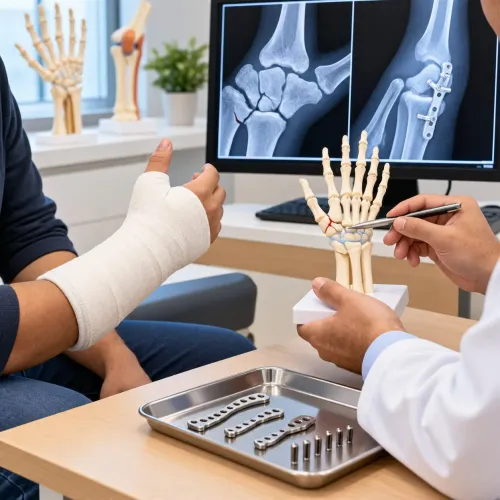
Fixation usually involves anaesthesia, an incision directly over the clavicle, reduction of the fragments, and a plate secured with screws on the surgeon’s chosen surface of the bone. Intramedullary fixation, using a rod inside the clavicle, is an alternative for selected fracture patterns.
A gap, nonunion or poor biology can require bone grafting. After surgery, hospital observation is followed by wound checks, dressing instructions, activity limits and review with follow-up X-rays. Ask:
- Which implant is planned, and where will it sit?
- When can shoulder movement and driving begin?
- How will physiotherapy progress from gentle movement to strengthening?
- Could prominent hardware irritate the skin or require later removal?
| Fixation approach | Practical feature | What to clarify |
|---|---|---|
| Plate and screws | Stabilises the fracture on a selected clavicle surface | Implant prominence, incision and removal risk |
| Intramedullary rod | Sits inside the bone | Whether your fracture pattern is suitable |
Removing an implant is a second operation, not a routine final step; it carries infection and refracture risks. Compare clavicle fracture treatment options in Bengaluru by confirming timely X-ray or CT, an orthopaedic trauma surgeon, anaesthesia, physiotherapy and follow-up imaging. A clavicle fracture specialist in Bengaluru should also explain the non-operative alternative.
Dr Harish Madrekar's Orthopaedic Clinic can provide an individual assessment comparing your images, medical risks, daily demands and that alternative rather than promising one treatment for every fracture.
Related service
FRACTURE SURGERY A clavicle fracture, commonly known as a collarbone fracture, is a frequent injury that can occur following a fall, road traffic accident, sports... View service → |
Frequently asked questions
What should you do immediately after a suspected clavicle fracture?
Support the injured arm in a simple sling or hold it against your body with the opposite hand. Keep the shoulder still, avoid pressing on a visible deformity and seek medical assessment.
What must the X-ray and clinical examination establish?
They must show the fracture location, displacement, shortening, number of bone fragments and whether the skin, nerves or blood vessels are at risk.
When is sling treatment better than a brace or surgery?
A sling is often appropriate for a stable, closed fracture with acceptable alignment and no threatened skin, nerve or blood-vessel injury. Your clinician should confirm the choice after examination and imaging.
When does clavicle fracture surgery in Bengaluru become reasonable or urgent?
Surgery becomes urgent when the bone threatens the skin or an open wound, nerve injury or blood-vessel injury is present. It becomes reasonable for selected displaced, shortened or unstable fractures after discussing healing, risks and recovery.
Keywords