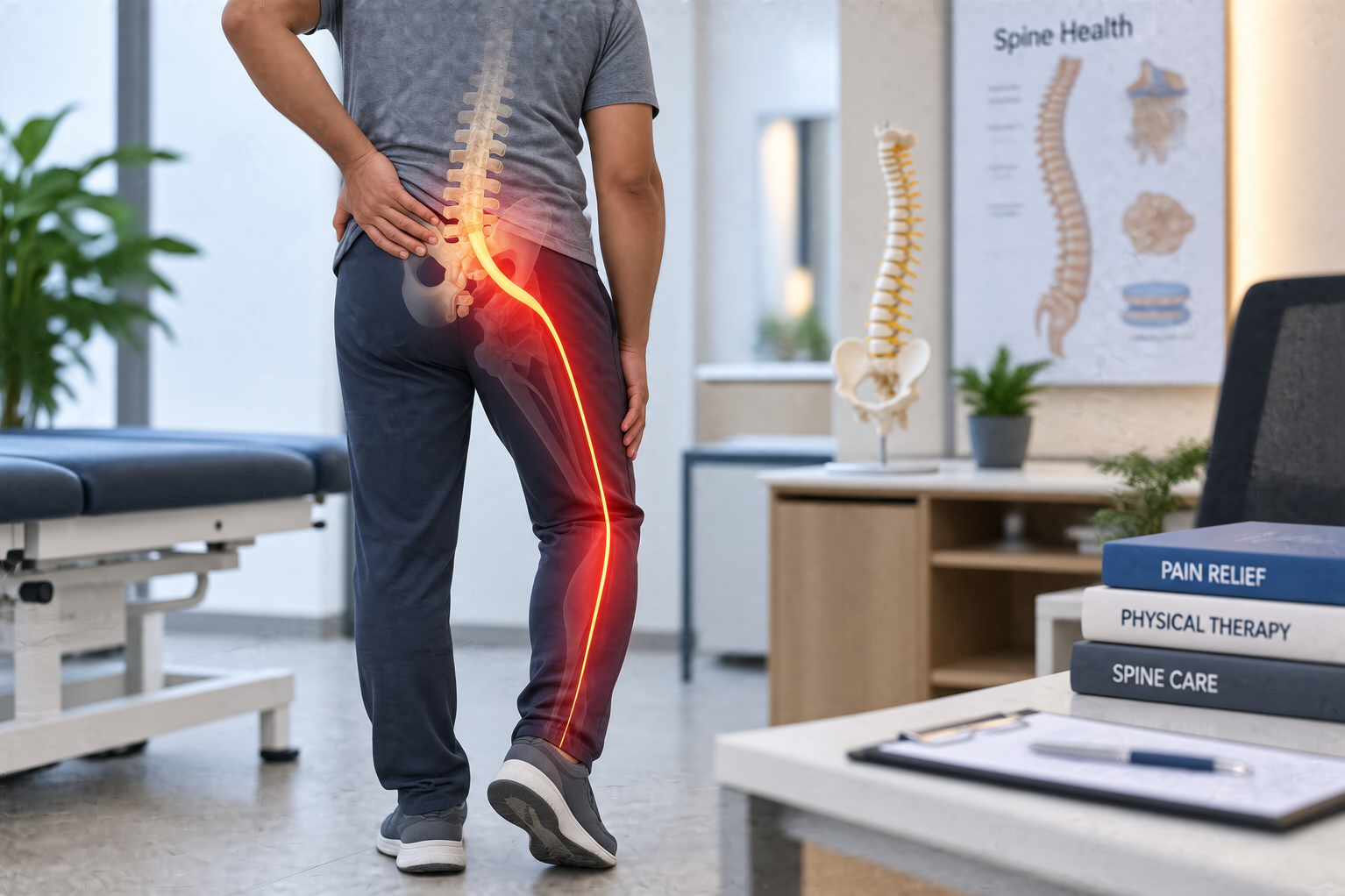
Pain beginning in the lower back or buttock and travelling down the leg can be difficult to ignore. It may feel sharp, burning, electric, or accompanied by tingling and numbness. When these symptoms follow the path of an irritated nerve, people commonly describe the condition as sciatica.
Choosing appropriate sciatica pain treatment starts with understanding the cause and identifying whether any neurological warning signs are present.
Sciatica is a description of symptoms rather than one specific disease. A lumbar disc problem is one possible cause, but narrowing around the nerves and other spinal conditions can produce similar symptoms.
Is every episode of leg pain sciatica?
No.
Muscle problems, hip conditions, peripheral nerve disorders, and other musculoskeletal conditions can sometimes mimic nerve-related pain.
A clinical examination may evaluate lower-limb strength, sensation, reflexes, spinal movement, nerve tension, and the distribution of symptoms.
This helps determine whether pain is likely to be arising from the lumbar spine and whether additional investigation is required.
Symptoms that deserve prompt attention
Certain changes are more important than pain intensity alone.
Seek timely medical assessment when back and leg symptoms are accompanied by progressive leg weakness, significant difficulty walking, changes in bladder or bowel control, or numbness around the saddle region.
Symptoms following significant trauma or accompanied by systemic concerns may also require further evaluation.
Does a slipped disc always require surgery?
No.
Many patients with disc-related sciatica can improve with non-surgical management. Treatment depends on the severity of symptoms and neurological findings and may include appropriate medication, modification of aggravating activities, and progressive rehabilitation.
Prolonged complete bed rest is generally not the goal for routine mechanical back conditions. Appropriate movement is often introduced according to the patient's tolerance and diagnosis.
When might an MRI be useful?
MRI can provide detailed information about discs, nerves, and other spinal structures, but it is not necessarily required immediately for every episode of uncomplicated back or leg pain.
Imaging becomes more relevant when there are neurological deficits, concerning clinical findings, persistent symptoms that are not improving as expected, or when intervention is being considered.
An MRI result should also be correlated with symptoms. Disc bulges and age-related spinal changes can sometimes appear in people who do not have corresponding pain.
When does surgery become a consideration?
Surgery may be discussed for selected patients with significant nerve compression, progressive neurological problems, or persistent disabling symptoms despite appropriate non-surgical care.
The decision should connect the clinical findings, imaging, duration of symptoms, and functional limitations.
For Bengaluru residents, long hours of sitting, lengthy commutes, reduced weekday movement, and sudden weekend exercise can contribute to back complaints, although these factors do not explain every case of sciatica.
At Dr Harish Madrekar's Orthopaedic Clinic, assessment can focus on identifying whether leg symptoms are related to nerve irritation and determining the level of care required.
The most useful goal is not simply reducing pain temporarily. Appropriate evaluation aims to protect neurological function, restore comfortable movement, identify contributing factors, and determine whether conservative management or further intervention is suitable for the underlying condition.
Keywords